
Free printable
Printable resistor colour code chart
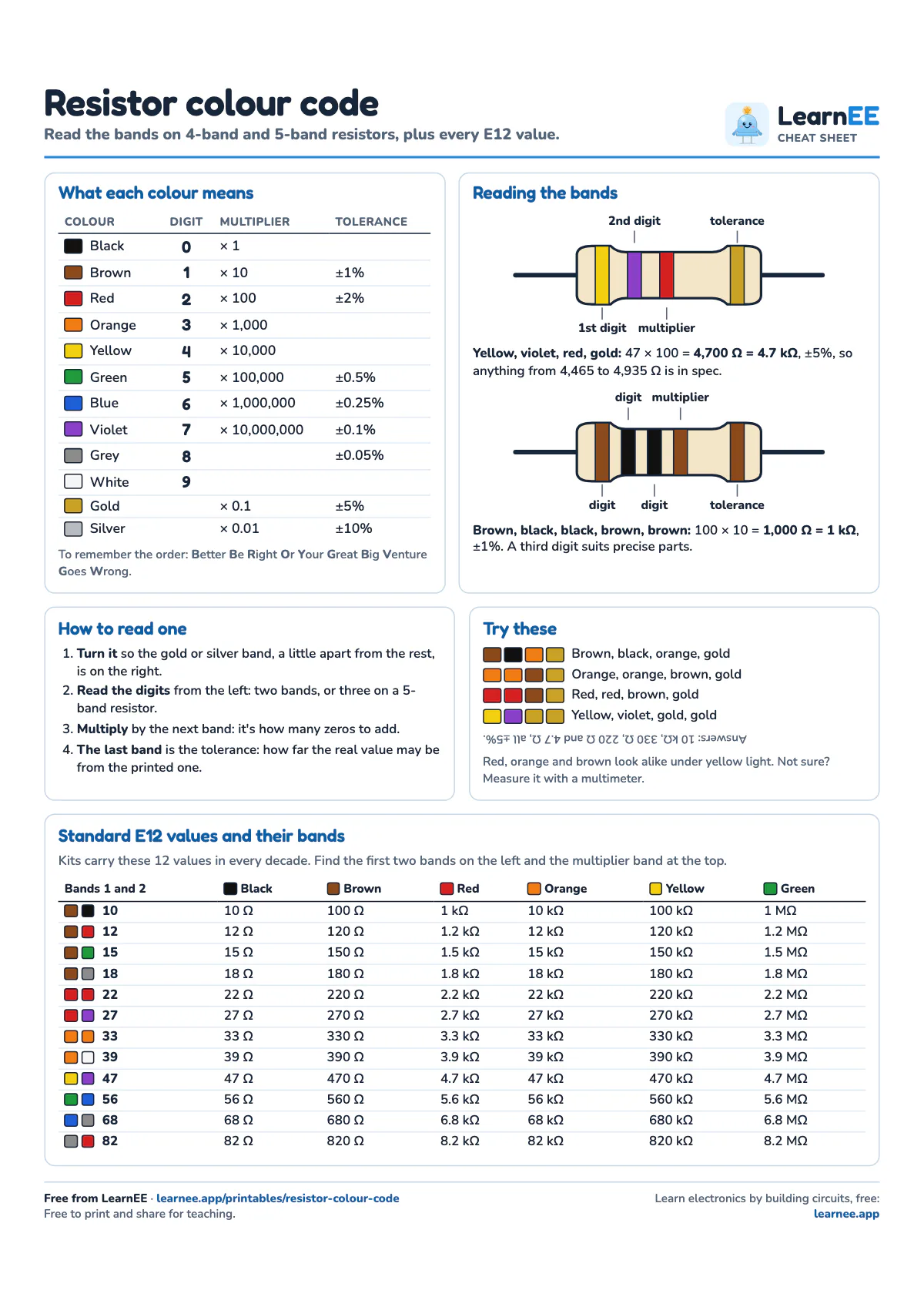
A one-page resistor colour code chart for the classroom wall or the workbench. It lists what every band colour means, shows how to read 4-band and 5-band resistors, and ends with the standard E12 values and their bands.
One page. Free to print and share for teaching. Print at actual size (100%), not fit to page. A4 suits most of the world; US Letter suits the USA and Canada.
What's on the sheet
- The colour table: black to white, plus gold and silver, with each colour's digit, multiplier and tolerance
- A 4-band and a 5-band resistor, each band labelled, with a worked example of each
- How to read one in four steps, and why red, orange and brown are easy to mix up
- Four practice resistors to read, with the answers printed upside down
- The E12 values from 10 Ω to 8.2 MΩ, with the colours of their first three bands
How to use it in class
Hand it out with a bag of mixed resistors and ask each student to read five, then check them with a multimeter. The practice resistors make a quick starter, and the E12 table answers "why can't I buy a 50 Ω resistor?" before anyone asks. Laminate a copy for each bench so it lives next to the parts.
Free lesson
Now build it yourself
Each lesson comes in three short parts: see the idea, try it on a live board, then build it yourself, with quick checks as you go.
“Resistance: the squeeze” is lesson 4 of 6 in Copper Flats, Electronics World 1. Free with an account. Lessons unlock in order, so you’ll do the 3 before it first.
Or start from the very first lesson, no account neededThe charts online
Work it out
The ideas behind it
Questions teachers ask
How do you read a resistor colour code?
Turn the resistor so the bands crowd to the left and the gold or silver band is on the right. Read the first bands as digits, multiply by the next band, and the last band is the tolerance. Yellow, violet, red, gold is 47 × 100 = 4.7 kΩ ±5%.
Is the chart free to use in class?
Yes. Print as many copies as you like and share them with students or other teachers. Each sheet carries a link back to the free lessons, so please leave the footer on.
Should I print the A4 or the US Letter version?
Pick the paper in your printer: A4 for the UK, Europe, Australia and most of the world, US Letter for the USA and Canada. Both hold the same chart on one page, so print at 100% (actual size) rather than fit to page.
More cheat sheets
- Printable Ohm's law and power cheat sheetThe V = I × R triangle, the power wheel, three worked examples, and units and prefixes.
- Printable electronics formula sheetOhm's law to resonance: the formulas students use most, grouped on one page.
- Printable circuit symbols chart32 schematic symbols, from cells and switches to transistors and op-amps, each named.
- Printable capacitor code chart3-digit codes, pF to nF to µF, tolerance letters and voltage codes on one page.
- Printable logic gates cheat sheetAll seven gates with symbol, truth table, Boolean expression and chip number.