
Free printable
Printable capacitor code chart
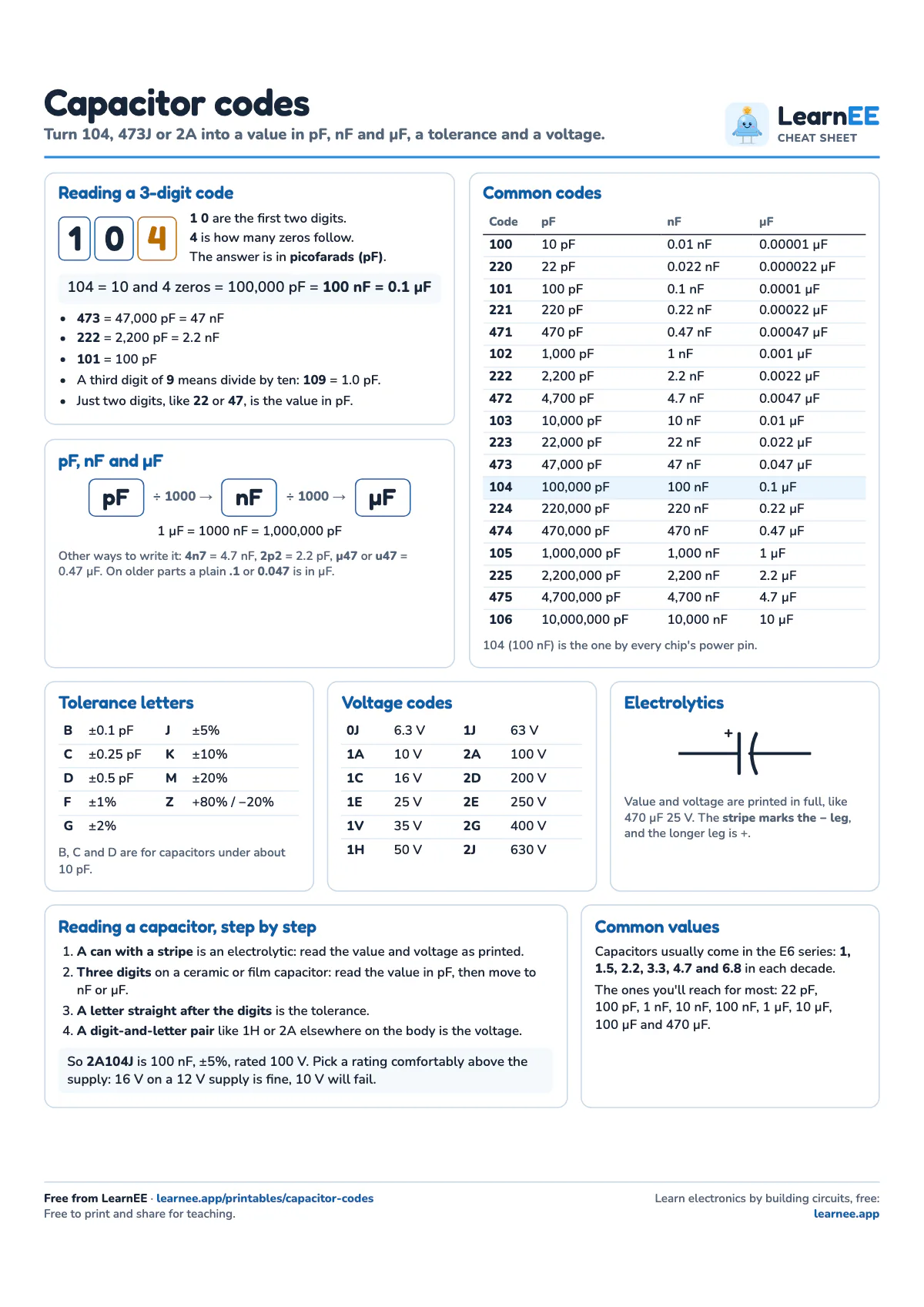
A one-page capacitor code chart for the workbench. It shows how to turn a code like 104 or 473J into a value, converts between pF, nF and µF, and decodes the tolerance letters and voltage codes printed on film and ceramic capacitors.
One page. Free to print and share for teaching. Print at actual size (100%), not fit to page. A4 suits most of the world; US Letter suits the USA and Canada.
What's on the sheet
- Reading a 3-digit code, with 104 worked through and three more examples
- Reading a capacitor, step by step, ending with 2A104J decoded in full
- pF, nF and µF: the ÷ 1000 ladder and the other ways values are written, like 4n7
- 18 common codes from 100 (10 pF) to 106 (10 µF) in all three units
- Tolerance letters B to Z and voltage codes 0J to 2J
- Electrolytic capacitors: which leg is negative and how to pick a voltage rating
- The E6 values capacitors come in, and the ones you'll reach for most
How to use it in class
Give each pair of students a handful of small ceramic capacitors and the chart, and ask them to sort the capacitors from smallest to largest by their codes. Then build an RC timer with two of them and compare the times. The conversion ladder is worth pinning up anywhere students do capacitor sums, since a slip between nF and µF is the most common mistake.
Free lesson
Now build it yourself
Each lesson comes in three short parts: see the idea, try it on a live board, then build it yourself, with quick checks as you go.
“Capacitors” is lesson 1 of 5 in Capacitor Caves, Electronics World 3. Free with an account. Lessons unlock in order, so you’ll do the 15 before it first.
Or start from the very first lesson, no account neededThe charts online
Work it out
The ideas behind it
Questions teachers ask
What does 104 mean on a capacitor?
10 followed by four zeros, in picofarads: 100,000 pF. That's 100 nF, or 0.1 µF, the capacitor that sits by every chip's power pin. The chart lists 18 common codes in pF, nF and µF.
Why are capacitor codes in picofarads?
The code was made for small ceramic and film capacitors, which run from a few pF to a few µF. Counting in pF keeps every value a whole number, so the code needs only three digits.
Which paper size should I print?
A4 for most of the world and US Letter for the USA and Canada. Both fit on one page; print at actual size rather than fit to page so the tables stay crisp.
More cheat sheets
- Printable resistor colour code chartEvery band colour, how to read 4- and 5-band resistors, and the E12 values with their bands.
- Printable Ohm's law and power cheat sheetThe V = I × R triangle, the power wheel, three worked examples, and units and prefixes.
- Printable electronics formula sheetOhm's law to resonance: the formulas students use most, grouped on one page.
- Printable circuit symbols chart32 schematic symbols, from cells and switches to transistors and op-amps, each named.
- Printable logic gates cheat sheetAll seven gates with symbol, truth table, Boolean expression and chip number.